The Course

Your dashboard is green. Your best people are drowning.

There's a reason — and it isn't effort. The 12 Laws of Healthcare Operations is the complete system as an online course: twelve mechanisms that explain why EDs board, why ORs run late, and why good teams stay stuck in firefighting.

Take the course on Udemy ›››

Launch pricing: $12.99 with code HANDOFF-LAUNCH through Aug 15 · list $109.99 · Udemy 30-day guarantee. The current best code always lives on this page.

What's Inside

Built to be applied, not binged.

Fifty-four video lectures plus a bonus resources hub — fourteen sections, three and a half hours. Every law follows the same four moves: the Law (what it says), the Mechanism (why it happens), a real Case (where it bit), and an Application you can run in your facility the same week.

A capstone walks you out with a 90-day plan built around your binding constraint. Every module includes a workbook page and a quiz — 24 downloadable tools in all.

Watch Before You Buy

A full lesson, free.

This is the mechanism lecture from Law II — The Utilization Paradox, exactly as it runs inside the course: why pushing occupancy toward 100% doesn't maximize output — it manufactures waiting, error, and fragility.

Below it is a page from the course workbook. Every module ends with one, so you finish each law having written something down about your own operation — not just watched.

Every lesson runs like this one: one law, one mechanism, real numbers, no filler.
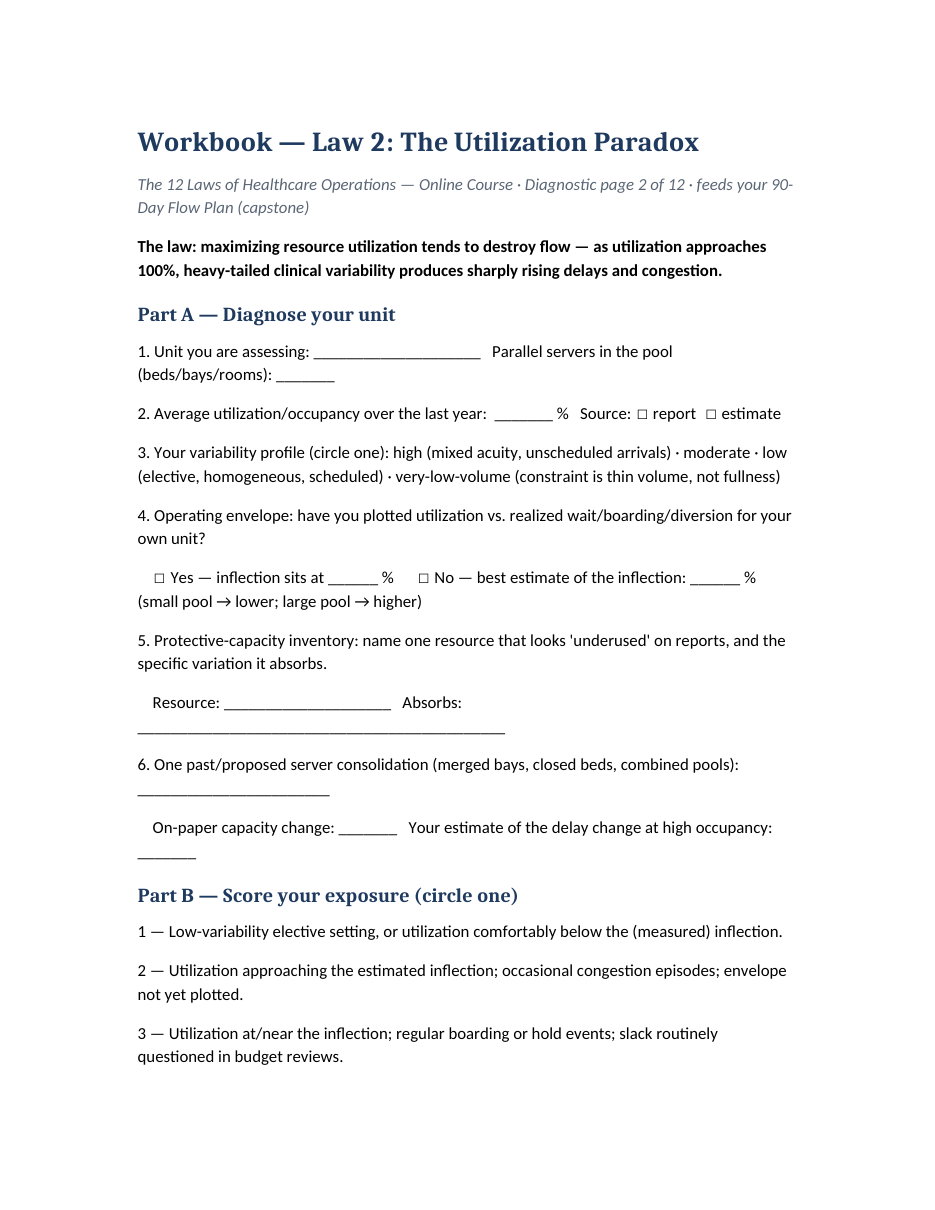
Course workbook page — Law II, The Utilization Paradox
What You Leave With

Not notes. A working plan.

The capstone converts the twelve laws into four deliverables for your own unit:

1.Your binding constraint

The one bottleneck actually governing your flow — named, located, and defended with evidence, not intuition.

2.A baseline metric

The number that tells the truth about that constraint today, so improvement becomes measurable instead of anecdotal.

3.A prioritized intervention

The highest-leverage design change the laws point to — chosen because it moves your constraint, not because it's fashionable.

4.A 90-day plan

Week by week: what changes, who owns it, what you measure, and when you decide it worked.

Where this fits: The Handoff delivers the evidence weekly → the free tools diagnose → this course implements → the book makes the full argument → research partnerships adapt it to your organization.

The Twelve Laws

What the course teaches.

I.Invisible Work

The work nobody counts still consumes capacity. Systems collapse when the uncounted load is designed out of the schedule.

II.The Utilization Paradox

Pushing utilization toward 100% doesn't maximize output — it maximizes waiting, error, and fragility. Efficiency needs air.

III.The Variability Cascade

Small fluctuations upstream amplify downstream. A ten-minute delay at 7 a.m. becomes an hour of chaos by noon.

IV.The Fragility Principle

Optimized systems are brittle systems. Every buffer removed is resilience sold for throughput.

V.The Coordination Tax

Every handoff, every interruption, every extra team member levies a tax. Most organizations never see the invoice.

VI.The Team Familiarity Effect

Teams that work together repeatedly outperform assemblies of equally skilled strangers — a quiet, compounding advantage.

VII.The Workforce Stability Rule

Turnover isn't an HR metric; it's an operational one. Instability degrades performance long before anyone resigns.

VIII.The Discharge Bottleneck

Hospitals don't fill up at the front door — they fail at the exit. Flow out governs flow in.

IX.The Clinic Capacity Illusion

The schedule says there's room; the system says otherwise. Paper capacity and real access are different quantities.

X.Measurement Error

What you measure badly, you manage badly. Most operational data measures the documentation, not the work.

XI.The Slack Requirement

Slack isn't waste — it's the price of reliability. Systems without designed slack borrow it, at interest, from people.

XII.The System Design Law

Every system is perfectly designed to get the results it gets. When performance fails, interrogate the design before the people.

Who It's For

If making healthcare work is your job.

Operators who own a unit, a clinic, a service line, or a schedule. Clinical leaders who keep inheriting broken processes. Educators building the next generation of allied-health and nursing professionals. The laws are already acting on you — the course teaches you to see them, and to design around them.

The Instructor

Research first.

I'm Shane Welter — PhD candidate in Business at Virginia Tech, researcher in healthcare and behavioral operations, builder of allied-health programs across six campuses, former operator. This course is the operational physics the published evidence keeps confirming — and my own research keeps testing: parsimonious, transparent, and built for resource-constrained environments, not just academic medical centers.

Enroll now — $12.99 launch code ›››

Not Ready Yet?

Start free.

Everything free lives on one page: the Bottleneck Finder diagnostic, the Field Pack, and the full Flow Architect Toolkit. Or read The Handoff — the weekly newsletter where the research lands first. The book arrives next; the course is the system, teachable today.