The Book

The 12 Laws of Healthcare Operations.

What hospitals reveal about how complex organizations really work. Manuscript complete — now seeking representation and a publisher; updates via the newsletter.

Join the book launch list ›››

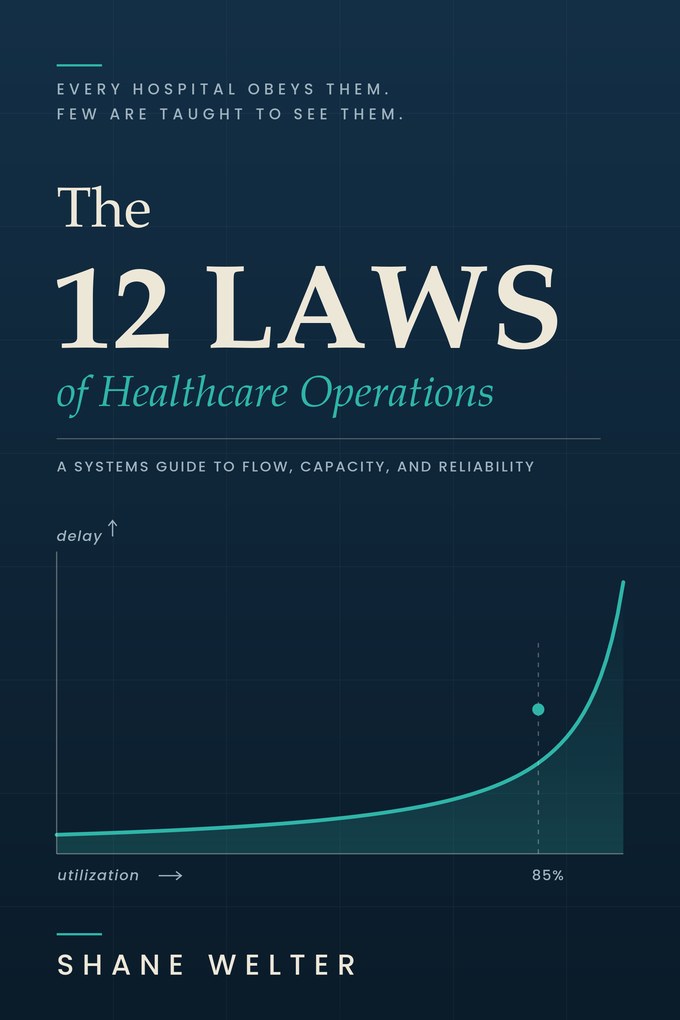
The 12 Laws of Healthcare Operations — book cover

Every hospital obeys the same operational physics. Work that nobody counts still costs. Systems run at 100% utilization fail more, not less. Small variability upstream becomes chaos downstream. These aren't management opinions — they're laws, visible in the data across decades of research, and they govern any complex organization, not just hospitals.

The book names the twelve, shows the peer-reviewed evidence behind each, and teaches the design moves that change outcomes. Written for operators, clinicians, students, and anyone who has watched a well-intentioned plan die on contact with reality.

The system isn't waiting for print. The complete 12 Laws — every law, mechanism, case, and application — is live now as an online course, with a 90-day capstone plan and 24 downloadable tools. Take the course →

The Laws

All twelve.

I.Invisible Work

The work nobody counts still consumes capacity. Systems collapse when the uncounted load is designed out of the schedule.

II.The Utilization Paradox

Pushing utilization toward 100% doesn't maximize output — it maximizes waiting, error, and fragility. Efficiency needs air.

III.The Variability Cascade

Small fluctuations upstream amplify downstream. A ten-minute delay at 7 a.m. becomes an hour of chaos by noon.

IV.The Fragility Principle

Optimized systems are brittle systems. Every buffer removed is resilience sold for throughput.

V.The Coordination Tax

Every handoff, every interruption, every extra team member levies a tax. Most organizations never see the invoice.

VI.The Team Familiarity Effect

Teams that work together repeatedly outperform assemblies of equally skilled strangers — a quiet, compounding advantage.

VII.The Workforce Stability Rule

Turnover isn't an HR metric; it's an operational one. Instability degrades performance long before anyone resigns.

VIII.The Discharge Bottleneck

Hospitals don't fill up at the front door — they fail at the exit. Flow out governs flow in.

IX.The Clinic Capacity Illusion

The schedule says there's room; the system says otherwise. Paper capacity and real access are different quantities.

X.Measurement Error

What you measure badly, you manage badly. Most operational data measures the documentation, not the work.

XI.The Slack Requirement

Slack isn't waste — it's the price of reliability. Systems without designed slack borrow it, at interest, from people.

XII.The System Design Law

Every system is perfectly designed to get the results it gets. When performance fails, interrogate the design before the people.

Each law gets a chapter: the law, the mechanism, the case, and the application — with every number traceable to the peer-reviewed source. See the research behind the laws in sixty-second Shorts.

Free Companion Tools

The Flow Architect Toolkit.

Every tool from the book is built and free: a board-ready ROI calculator that prices your hospital's cost of congestion, diagnostic workbooks, a 12 Laws wall poster, a 12-week huddle guide, a leadership tabletop simulation, a graduate teaching case, and a policy brief for boards and regulators. For adopting programs, a full Instructor's Manual — sixteen slide decks, a test bank, rubrics, and teaching datasets — is available on request.

Three kits — for operators, for teams, and for classrooms & policy. One email unlocks everything.

Get every tool free →   Executive brief (PDF) ↓

Where this fits: The Handoff delivers the evidence weekly → the free tools diagnose → the course implements → this book makes the full argument → research partnerships adapt it to your organization.

Evaluating the book for your leadership team or board? The Physics of the Full Hospital is a six-page executive brief: what running hot costs, all twelve laws with their anchor evidence, and five numbers to commission this month.